Engineered Arts AmecavsFourier Intelligence GR-1
Side-by-side comparison of Engineered Arts Ameca and Fourier Intelligence GR-1: specs, price, use cases and SDKs.
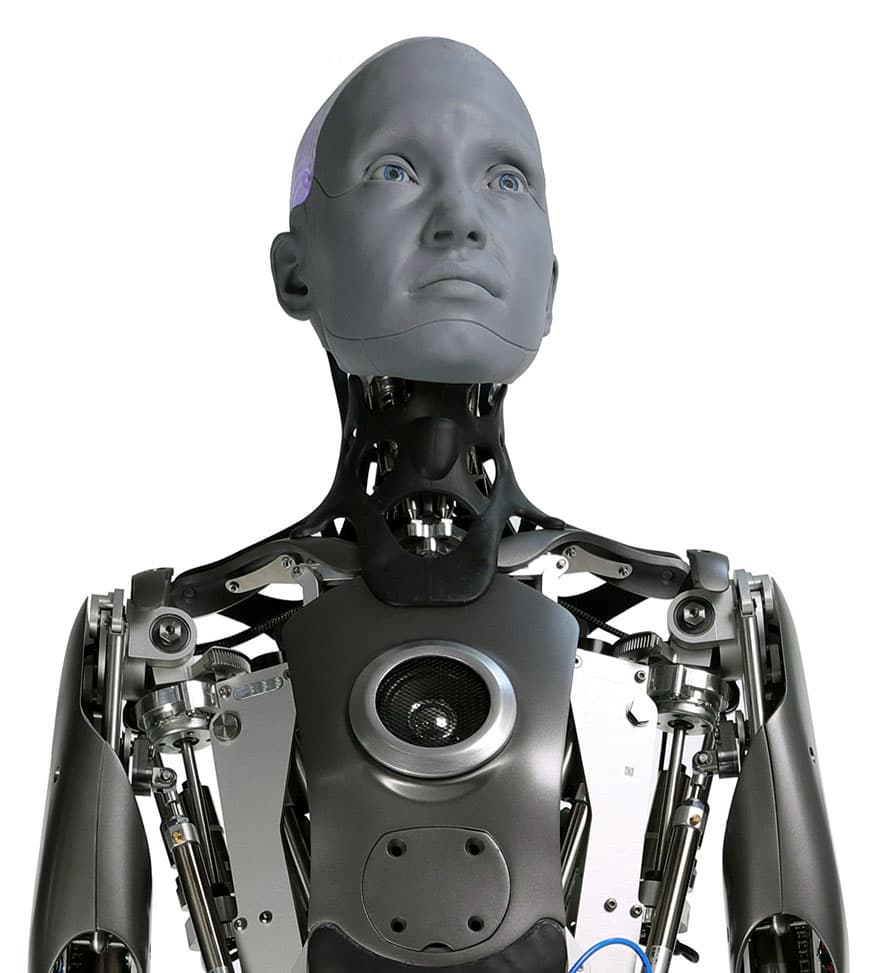
Ameca
Hyper-realistic humanoid face + upper-body for HRI research

GR-1
Open-platform humanoid for research + light industrial pilots
Specifications
| Spec | Ameca | GR-1 |
|---|---|---|
| Price (USD) | $175,000 | $150,000 |
| Category | humanoid | humanoid |
| Payload | — | 50 kg |
| Runtime | — | 2 h |
| Speed | — | 1.4 m/s |
| Weight | 50 kg | 55 kg |
| Reach | Upper-body humanoid | — |
| Degrees of Freedom | 51 | 40 |
| Battery | — | Li-ion swap |
- HRI research
- Museum / theme park installations
- Brand activations
- Film + TV
- University research
- Light manufacturing pilots
- Rehabilitation R&D
- Robotic hand teleoperation studies
When to pick which
Choose the Engineered Arts Ameca for high-stakes public engagement and social robotics research where human-like expression is the primary requirement. In scenarios like museum installations or luxury brand activations, Ameca’s 51 degrees of freedom—specifically its hyper-realistic facial articulation—provide a level of non-verbal communication and emotional resonance that mechanical humanoids lack. For developers building advanced conversational agents, the native Tritium OS and LLM plugins for OpenAI and Google allow for rapid deployment of interactive personas. If your deployment constraint is maximizing audience immersion and social presence rather than physical mobility, Ameca is the superior investment.
Opt for the Fourier Intelligence GR-1 for full-body mobility research and light industrial pilot programs. Unlike the upper-body-focused Ameca, the GR-1 is a complete bipedal platform capable of walking at 1.4 m/s and carrying a substantial 50kg payload. This makes it ideal for university labs studying gait dynamics or logistics firms testing autonomous material transport in constrained environments. The inclusion of ROS2 drivers and a Python SDK provides a standard, open-platform environment for developers to integrate custom sensors or teleoperation hardware. At a lower $150,000 price point with swappable batteries, it supports continuous testing cycles in rehabilitation R&D.
Ready to evaluate?
Request a vendor quote or compare more options.